
Parola: Learning new languages in practical ways and the right context.
Parola is an offline-first Android app that teaches practical Italian around the learner's own life: their job, home, people and the places they visit every week.

The problem
language apps teach a generic syllabus on a fixed schedule. Adults living abroad need the words for their own life, at the moment they need them, with real conversation practice that still builds toward something.
Overview
Parola is an offline-first Android app that teaches practical Italian around the learner's own life: their job, home, people and the places they visit every week. It pairs a structured learning path with live AI conversation in ChatGPT voice, and keeps the app in charge of progress through a brief-and-recap protocol.
I led Parola end to end as product designer and front-end developer, from research and UX through UI, motion and the Android build. The project ran for six weeks, from September to October 2026, and shipped as v1.1 with five core areas, 29 location packs and 49 lessons, at an AI cost of a few cents a month.
The problem
Mainstream language apps are built for learners who study a language, not for people who have to live in one. Three gaps came up repeatedly before any research began.
-
No context about the learner's life. Apps like Duolingo ask why you're learning, then teach everyone the same sentences. A freelance designer in Pescara gets "the boy eats an apple" instead of "I work mainly with clients in the UK". Effort goes into words the learner will never say.
-
Conversation without structure. AI voice tools such as ChatGPT voice are now excellent conversation partners. But an open chat has no curriculum, no memory of past mistakes and no sense of progress. Learners either drift or repeat the same comfortable topics.
-
No help in the moment. Real need arrives at the deli counter, the post office or on a courier's call. Apps are designed for planned sessions, not the three seconds before you speak. Words that keep slipping away are either lost in history or pushed into drills the learner never asked for.
Underneath all three sits a fourth issue: streaks, hearts and reminders treat adults as users to retain, rather than learners who decide what matters to them.
Research
Four methods tested the three starting assumptions, moving from what exists, to one learner's real days, to a wider group.
I started wide with a competitive audit of six products, then went deep with a 21-day diary study, logging 64 real moments of needing Italian. Contextual interviews with eight adults who had relocated to Italy, Spain or Portugal explained the why behind those moments. Finally, a survey of 46 people from expat and remote-worker communities tested how widespread the frustrations were.
No product combined personal context, real conversation and learner-led progress. Tools that are good at conversation forget everything between sessions; tools with structure ignore the learner's life.
Structured courses such as Duolingo and Babbel know a learner's goal but nothing else about them. Duolingo's AI calls are scripted and premium-only; Babbel's live classes cost extra, and both move learners along a fixed path. Anki is powerful for memory, but the learner builds every deck, and an algorithm decides when to review.
At the other end, ChatGPT voice is the best conversation partner available, yet it forgets the learner between sessions and has no curriculum. Google Translate and phrasebooks help in the moment, but teach nothing and keep no record. The opportunity sat squarely in the gap between the two groups.

Key insights
Affinity mapping of 140+ notes from the diary, interviews and open survey answers produced five insights that shaped every later decision.
The strongest pattern was simple: relevance is the motivation. Learners stayed engaged when content was about their own job, home and people, and generic sentences were the most common reason for quitting.
Need was also triggered by place, not by schedule. Most language moments were tied to a specific location and arrived without warning, so retrieval speed mattered more than lesson depth. And in those moments, hearing was the hidden half. Learners prepared what to say, then lost the thread at the reply, which made preparing for what staff say back as important as anything a phrasebook offers.
Conversation practice told a similar story. Voice AI was the most valued tool, but without a memory or a direction, sessions felt disconnected, with no record of mistakes and no sense of progress.
Finally, adults want agency, not pressure. Forgetting the same words is normal and should be visible rather than punished, and learners wanted to decide for themselves when something counted as understood.

Visual Design
The visual language had to feel confident and warm, not like homework. "Adriatic Pop" draws on Pescara's coastline: saturated sea blue, sun yellow and tomato red on a warm paper background.
Three directions were tested as moodboards: a muted editorial look, a playful illustrated look and a bold graphic look. The bold direction won because it gave each place category its own hue, which made packs recognisable at a glance in the moment of need.

Technical approach
Design constraints became architecture decisions. Offline-first, low-cost and private were solved in the build, not left as aspirations.
Works without signal
All content lives in on-device SQLite. Starter packs and the learning tree ship as bundled data and seed on first launch.
Near-zero running cost
I is called only for new lookups, new place packs, profile phrases and Coming-up packs. Every result is cached permanently, and exact matches never call the API.
Conversation without cost
Voice practice runs in the learner's existing ChatGPT subscription, and recap parsing happens on device.
Fast, offline audio
Android text-to-speech uses an Italian voice downloaded once.
Private by default
Profile data only leaves the device when a card is toggled on. The API key sits in encrypted storage, and backup is a single local file with no cloud sync.
Transparent spend
A usage counter in Settings shows calls and estimated cost for the month.
The app is built in Expo and React Native with TypeScript, using Reanimated for motion and react-native-svg for the generative illustrations. Lookups use a small, inexpensive OpenAI model with structured JSON output, which keeps every result consistent with the phonetic and register conventions.


The solution
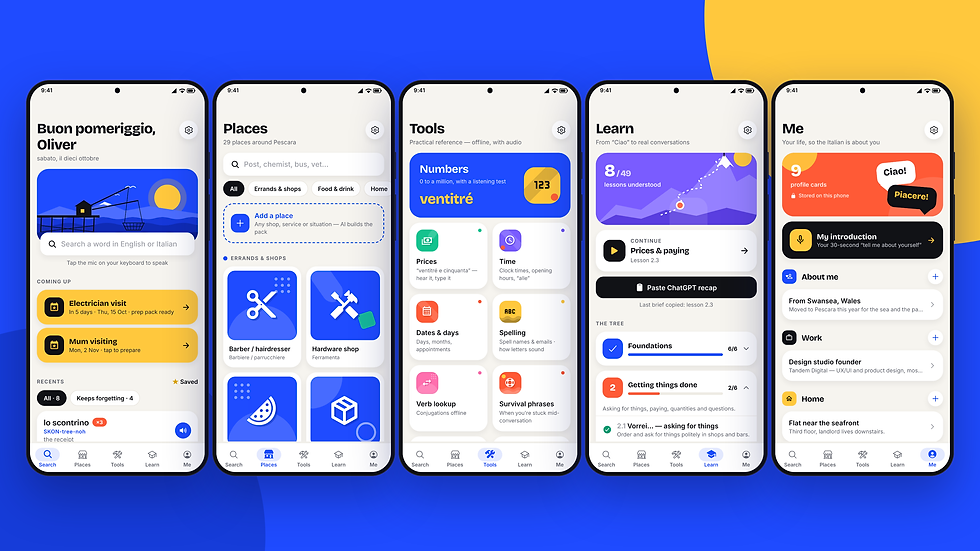
Parola answers the three gaps with three connected pillars, supported by a set of offline Tools. Five tabs carry them: Search, Places, Tools, Learn and Me.
1. Me: a profile that makes everything personal
The learner describes their life in short, plain-English cards. Everything else in the app reads from them.
Eight card categories: About me, Work, Home, People, Routine, Interests, Coming up and Preferences. Every field is optional and can grow over time.
Personal phrases: each card generates a small set of Italian sentences with phonetics and audio, such as "Sono un designer freelance, lavoro soprattutto con clienti nel Regno Unito." Phrases regenerate only when the card changes.
Self-introduction builder: a simple and a fuller 30-second answer to "tell me about yourself", the question learners are asked most.
Tailoring: lesson briefs include up to ~100 words of relevant profile, and profile entries suggest new places (a dog suggests a Vet pack).
Coming up: dated events such as "electrician Thursday" generate a mini-pack that sits on the home screen until the date passes. No notifications.
Privacy controls: cards stay on the device, each has an "Include in AI" toggle, and a brief preview shows exactly what will be shared.
2. Learn: live conversation with guardrails
A learning tree of 49 practical lessons in 10 branches runs from "Ciao" to connecting ideas. Each lesson moves from Not started to Practising to Understood, set by the learner and reversible.
Practice happens in ChatGPT voice, but the app sets the terms. Copy brief packages the lesson goal, grammar point, vocabulary, a linked place scenario, relevant profile, up to five weak words and past mistakes, plus coaching rules. When the learner says "finito", ChatGPT returns a recap in a fixed format that the app can parse.
3. Search and Places: help in the moment
Search is the home screen. Learners type or speak in English or Italian, and results come from local content first, then places and tools, and only then a single AI lookup. Each lookup returns the Italian, English, phonetics with the stress in capitals (spe-DI-re), gender, plural, register and an example. It is saved permanently, so the second lookup is free.
Recents show a count beside each word. Look something up twice and it joins a Keeps forgetting filter: visible, but never turned into drills. Every phrase plays at normal and slow speed, and opens as a full-screen Show card to turn towards a clerk.
Behind search sit 29 place packs across errands, food, home, transport, health, admin and social life. Each has three parts: Say, Hear for what staff are likely to reply, and Key words, plus local expressions to listen for. "Add a place" generates a new pack in a single call.
Supporting: Tools
Offline references for the things that trip people up at speed: numbers, prices and times with listen-and-type tests at native pace, dates, the Italian spelling alphabet with ready-made name and email cards, an offline verb conjugator, phone-call scripts, Lei vs tu, and deli measures.


Reflection
Owning less made the product stronger. Rejecting an in-app voice tutor felt like a gap at first. Orchestrating an existing tool turned out to be the most valuable and cheapest decision in the project.
Structure can live in a format. A plain-text recap template gave an AI conversation the same accountability as a lesson, with no integration at all.
Listening deserved more weight from the start. The research flagged it early, but it was the field test that made Hear a first-class feature.
Respecting autonomy is a design choice, not an absence. Removing streaks and drills required designing visibility instead: counts, statuses and a "Keeps forgetting" list.